
Mindful donations center on guarding the dignity of the guests in a church’s refugee and migrant program while communicating thoughtfully with your community and donors, according to Desiree Townley, who recently gave a Community of Practice sessions for coordinators who are heading projects funded by the Convocation Refugee Grant Program (CRGP) across Europe. Townley, who has worked in costuming for dance and opera companies, is a second-hand clothing expert at the Joel Nafuma Refugee Center (JNRC) located at St. Paul’s within the Walls in Rome.
“Language really matters,” she emphasized, “particularly when communicating with donors and your community about what you really need.” She encouraged program leaders to communicate well with social media and their newsletters about what they DO need. This helps donors give mindful donations while also helping center volunteers graciously refuse unsuitable or unusable donations. “You can refer to the earlier communications and it doesn’t feel like you’re making it up on the spot. We don’t want people bringing things to our doorsteps that we don’t need and will take up our time and energy to redistribute.”
At the same time, “always say: ‘We appreciate your thoughtfulness’,” she advised. “People who are donating really have a heart for what you are doing so meet them, if at all possible, when they come in. Ask if you can sign them up for your newsletter, so they can be kept in the loop. Pull them into your community,” she advised.
“Dignity is essential” when it comes to distributing the clothing, she stressed. “Think about how you can thoughtfully distribute to your community. Everyone does it differently because everyone has a different space.” Some best practices are: making sure the clothing is displayed attractively, having volunteers to greet and assist the guests, allowing the guests time to choose their clothing, and providing—if possible—a small space with a mirror to try things on, particularly for women and children.
“Our women’s room is meant to be a place of peacefulness where the women can come, have space away from menfolk in the community, and just be with each other. They can feel like they’re in a little shop, like they get to choose. We want to find small ways to give respect.”
For all their guests, “We let them take a breath with us so that they can make their own decisions. This is very important; they do not want to be handed something that we have chosen for them, even if they might need help choosing a good fit,” Townley said.
Teaching the community, both volunteers and their guests, about care and mending of clothing is another vital part of the team’s work at JNRC. One volunteer, Paula, “is teaching everyone at our center how to mend a button. A lot of young people aren’t taught these skills anymore and it’s important our volunteers leave with new skills, so we’re doing skill sharing,” she said.
They’re also aiding their guests in mending their clothing. “Just like you and I, they are very attached to their things, and it can make them feel quite at home to be able to keep what is already on their body. They don’t want a new coat; they want the coat they have on with a working button. And it makes us feel good that this person gets to leave with what is valuable to them.”
Some of Townley’s recommendations were for the members of congregations working with refugees. Most important is to “mindfully re-home.” Ask the center or program leaders in advance what they truly need. And think about the environmental and human cost of fast fashion when buying your own clothing. “We all want to care about the planet and the human beings living on it.”
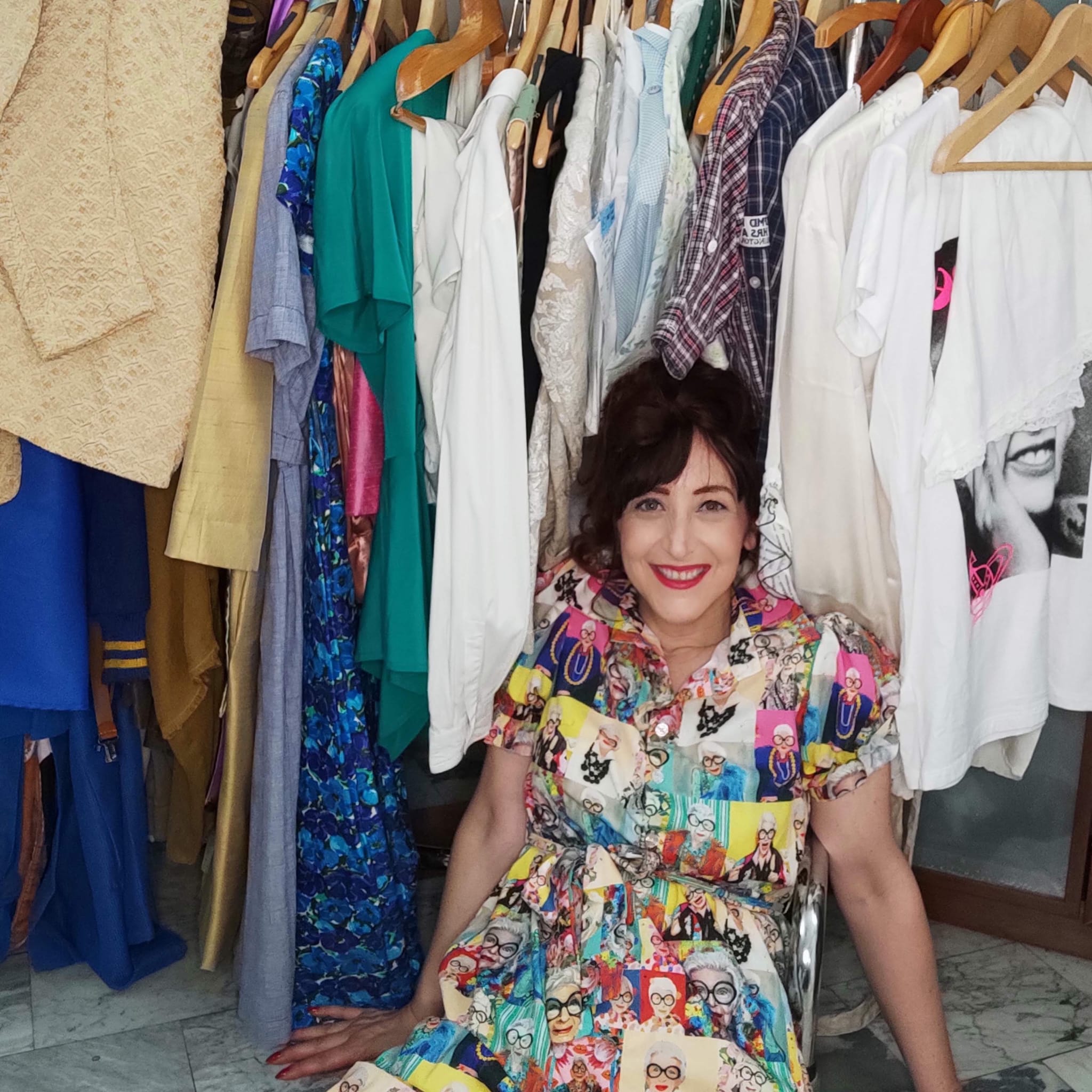
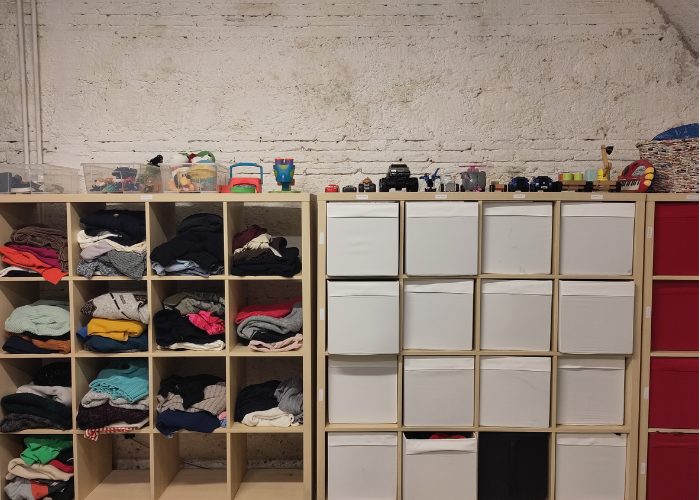
Left: Desiree Townley; above: an organized shelf full of mindfull donations