
Easter, 2026
If you temper your spiritual life by the daily onslaught of troubling news, you might find it impossible to believe that our Lent will ever come to an end. Wars and rumors of wars surround us; indeed, if anything there is more violence and conflict in the world today than forty days ago, when our Lent began.
Verities we had long trusted are crumbling before our eyes. Whole systems of relationships that have shaped and nourished our expectations—whether between states, or between the churches of our Anglican Communion, or even between neighbors and friends—are straining and breaking.
Our hearts are heavy. Yet consider, if you can, what is carried in the heart of Jesus as he walks under the burden of the Cross up the hill. The whole cosmic tragedy of our collective rejection of God’s love for us, our refusal of God’s intent that we live in the unity of love with God and each other, is the burden on his back.
In words and signs, by mildness and miracle, he has tried to show what that life looks like. But we, too afraid or too proud, cannot bear to imagine it’s true. We, too certain of ourselves or too centered on our own needs, cannot accept the interdependence for which God made us, and to which God calls us.
And yet, and yet—our refusal, our rejection of God’s invitation, does not matter in the end. Even that is overcome by the power of love. On Easter, Christ overcomes not only the death of the body, but the countless little deaths of our rejections and refusals. All of it is transformed into the relentless, unyielding possibility of love—because God wills it.
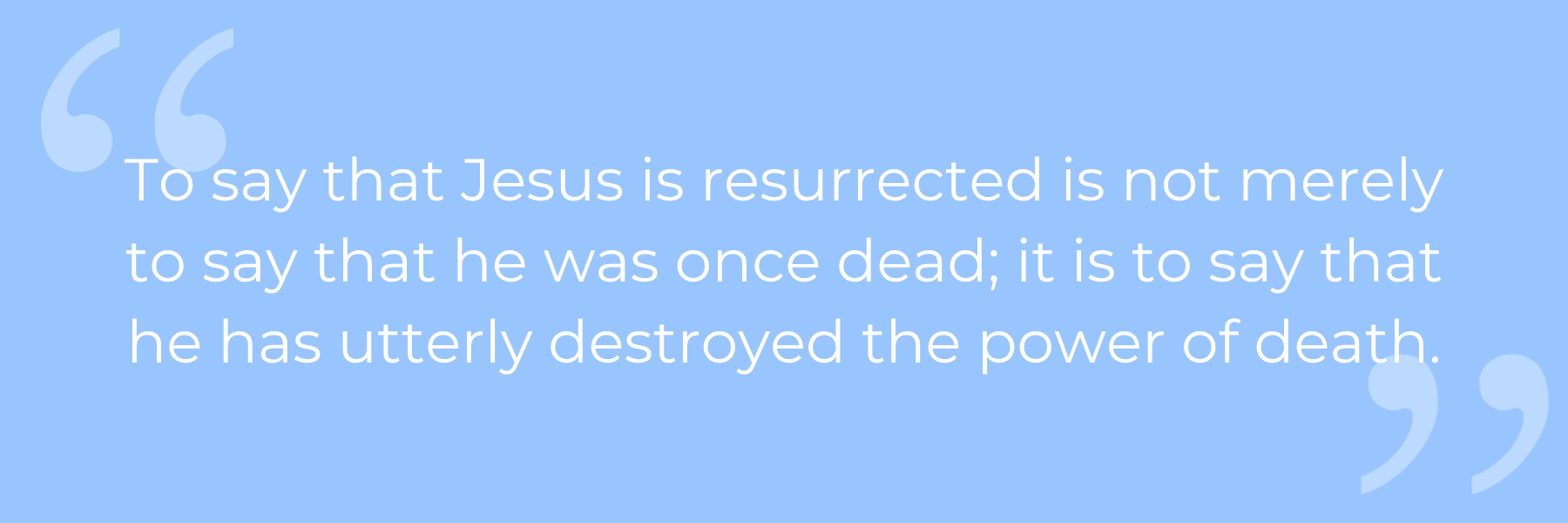
We miss the point of this if we think of Easter morning merely as the resuscitation of a temporarily dead Jesus. That negates the power of what has happened. Jesus is resurrected, not revived. It is a final and full realization of who Jesus is—of who, and what, we are meant to be. To say that Jesus is resurrected is not merely to say that he was once dead; it is to say that he has utterly destroyed the power of death—and even overcome the power of our rejections and refusals, of all our little deaths—once for all time and for all of us.
The question now is whether we will set aside our refusals of love’s invitation and enter into the full realization of who God made us to be, too. “For me to be a saint,” wrote Thomas Merton, “means to be myself. Therefore the problem of sanctity and salvation is in fact the problem of finding out who I am and of discovering my true self. Trees and animals have no problem. God makes them what they are without consulting them, and they are perfectly satisfied. With us it is different. God leaves us free to be whatever we like. We can be ourselves or not, as we please. We are at liberty to be real, or unreal. We may be true or false; the choice is ours.”[1]
So, listen on this Easter morning for Jesus’ summons, the same to us as it was to Lazarus: “Come out!” And then leave behind the darkness of our graves of refusals and self-deceptions, and welcome the light of God’s new day.
The Right Reverend Mark Edington
Bishop in Charge
The Convocation of Episcopal Churches in Europe
[1] Thomas Merton, New Seeds of Contemplation (New York: New Directions, 1962).