The original deed and building contract for the American Cathedral in Paris, as well as handwritten notes by Hamilton Fish—U.S. Secretary of State from 1869 to 1877, and one of the founders of the parish of the Holy Trinity in Paris, are amongst the treasure trove of documents recently rediscovered in the Board of Foreign Parishes’ archives.
“It’s been interesting,” said Schuyler Rowe, the BFP’s new Fay Historical Fellow. “The Board of Foreign Parishes has been exclusively volunteer-run for its entire existence. We have all these documents about the history of the organization—which was founded in 1883—that have passed from volunteer to volunteer to volunteer” but had never been catalogued in their entirety by the organization.
In 1981, the Episcopal Church Center in New York agreed to hold the BFP’s documents at their offices, and then, in the mid 1990s, the entire archives were moved to the Seminary of the Southwest in Austin, Texas. While the BFP documents had generally been catalogued by the Church Center archives staff, no one associated with the BFP had examined them in recent history.
“No one really knew exactly what was in there. We had some information that documents were donated to the main library at Harvard in the 1930s but no one could find them,” Rowe explained. “Previous BFP President Connor Fay planned to access and index the papers still held by members of the BFP, but a house fire in 2008 damaged many of those records.”
“So I was brought on board as someone with archival experience to basically find out what was in all the different boxes,” she said. “Thirty-one boxes to be exact.”
What Rowe has found covers everything from Fish’s original handwritten minutes of one of the first board meetings of the Board of Foreign Parishes to a reference of a bomb being planted in front of Emmanuel Church in Geneva in 1965. “The porter of church found this package, picked it up, and it went off in his hands. He lived but he lost a hand. And this is mentioned in this completely standard report about ‘What’s going on in the Convocation’.”
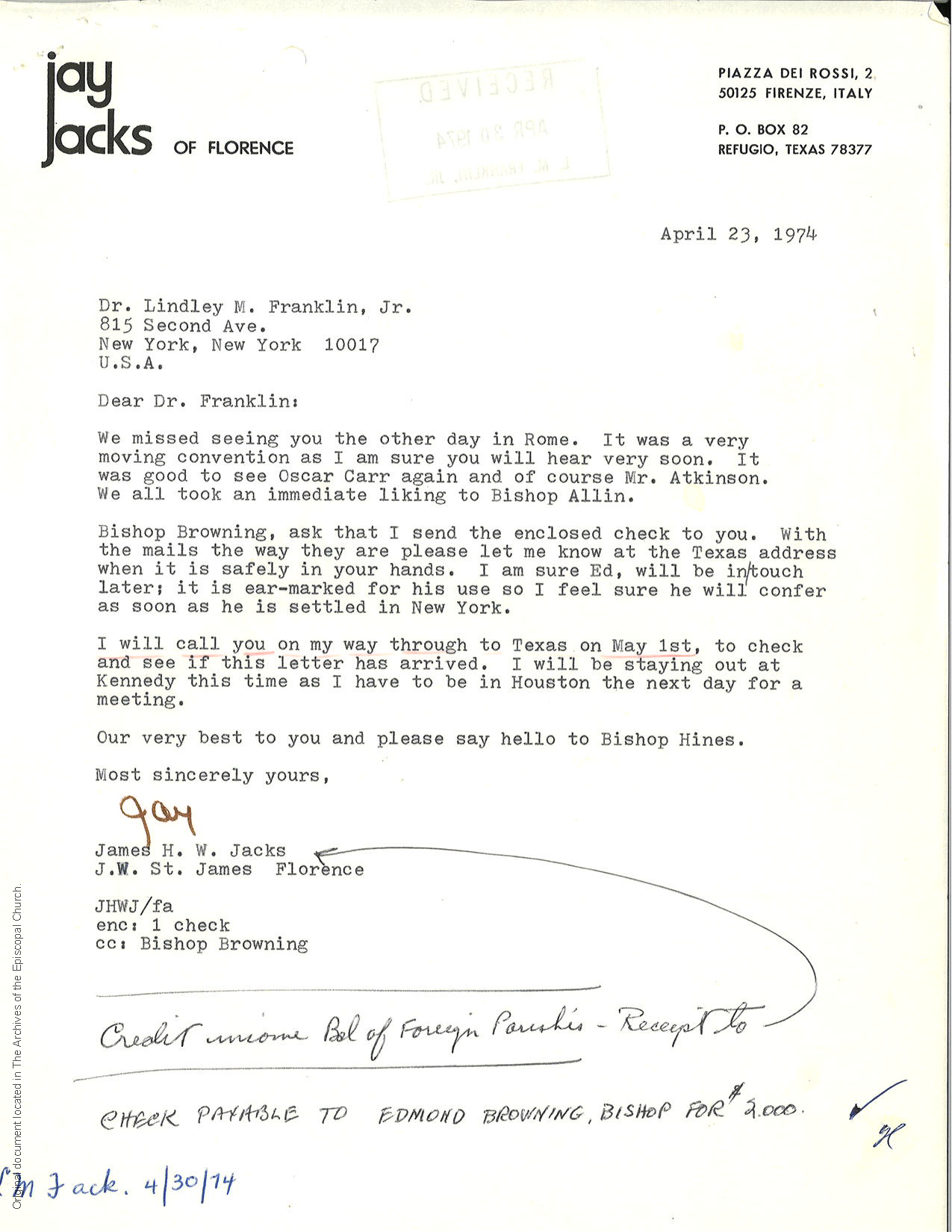
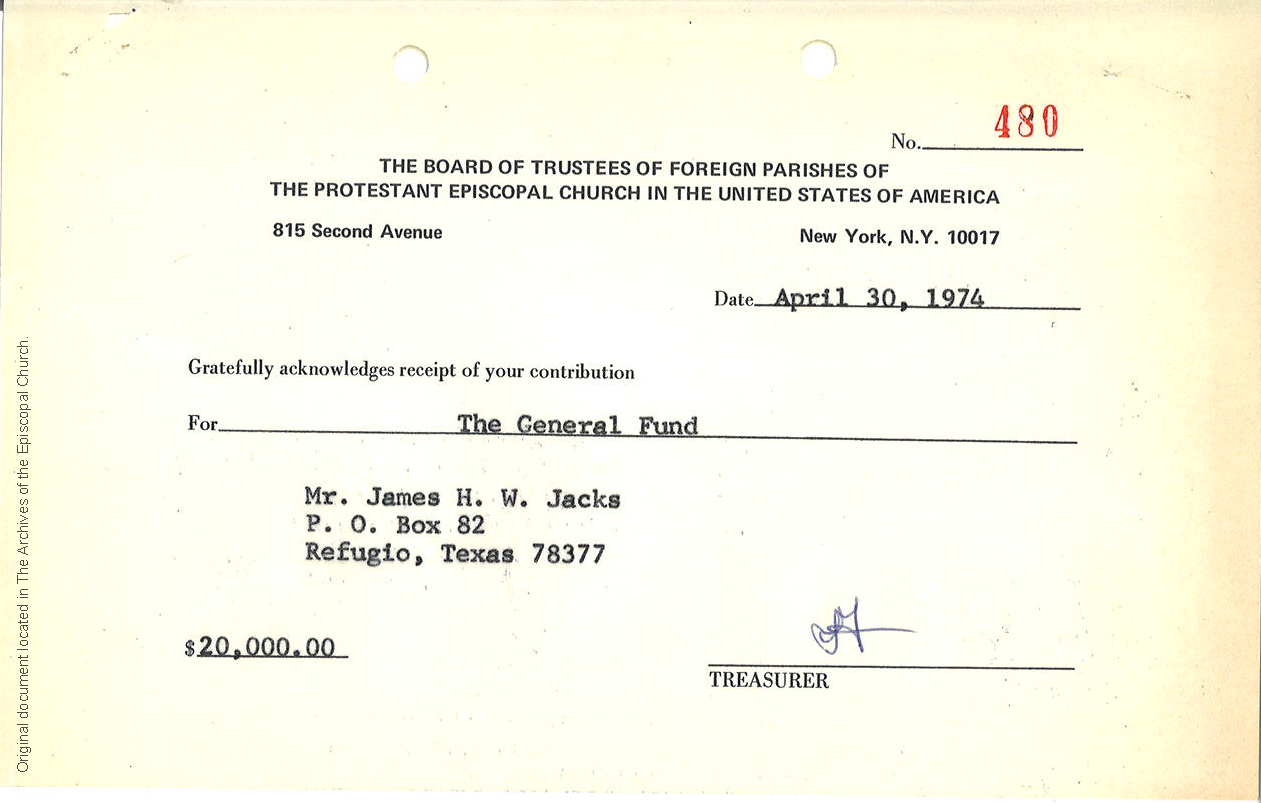
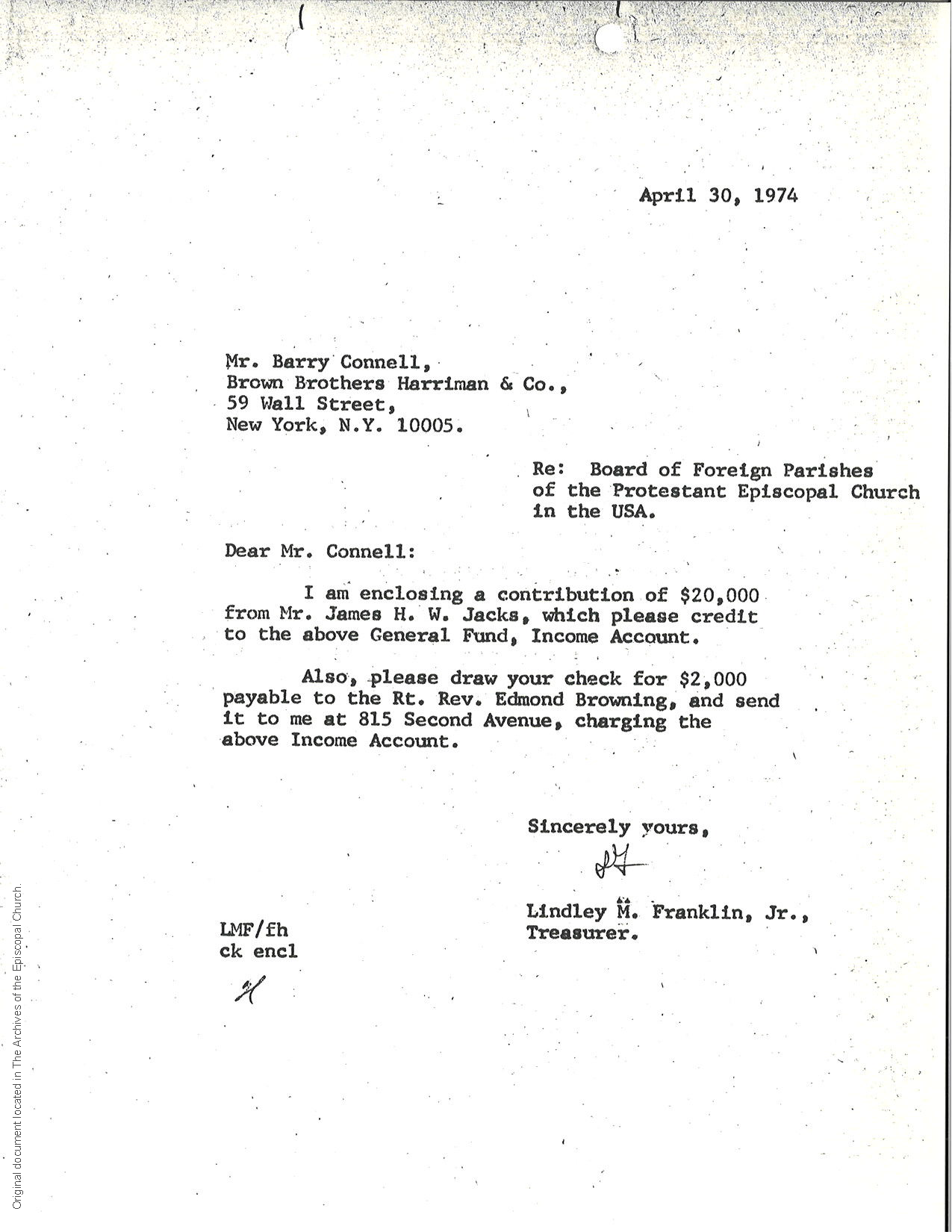
One of the more rewarding finds she made is letters and documents related to the establishment of the Convocation Fund in the 1970s, Rowe said. The Episcopal Church was struggling financially in the 1970s and cuts were made in the subsidies it provided to Episcopal churches in Europe. Jay Jacks, an oil executive and parishioner from both Refugio, TX, and Saint James’ in Florence, was also a childhood friend of Edmund Browning—who was the bishop-in-charge from 1971-1974 of what was then called the Convocation of American Churches in Europe. Browning, the first bishop-in-charge to live as a resident in Europe, had been seeking additional funding for the Convocation, and so Jacks sent him a $20,000 check to use as he saw fit to support the churches in Europe.
“Browning gave the money to the BFP, and that was the start of the Convocation Fund in 1972,” Rowe said. Jacks passed away in 2004. Rowe was able to show Jack’s widow, Marla, the original check and letter last fall. Marla Jacks Briggle is still active at Saint James’ Florence, serving as the president of its board and as a member of the Board of Foreign Parishes.