
The story of creation care at Emmanuel is a story about possibilities: what is possible, what might be possible, and what maybe, possibly, could be possible someday.
What Is Possible
Emmanuel is an urban church. Lake Léman and the Alps are very near and visible from the street in front of the church, but the church property is surrounded by a lot of human handiwork and precious little of God’s. Even our beautiful historic church building stymies efforts to be more environmentally conscious. We can’t put solar panels on the roof. We can’t tear up the wood paneled interior to add insulation. We don’t have room to plant a vegetable patch for the soup kitchen.
But we can make, and have already made, meaningful changes to reduce waste. Coffee hour is mostly waste-free: coffee is served in china mugs, and viennoiseries and other treats are served on china plates. What makes this possible, without condemning volunteers to an afternoon at the kitchen sink is a commercial-grade dishwasher that cleans a load of china in minutes.
We have reduced the amount of paper used for the Sunday service bulletin by reusing the basic bulletin from week to week and inserting a page for the parts that change. In the weeks after Pentecost, those bulletins are reused 25 times! The bulletin is already available online, for the people who stream the Sunday service, and there is talk of making it more mobile-friendly so that parishioners in church can participate paper-free. I hope when they are looking at their phones they will be following along with the service and not checking email.
What More Could Be Possible?
Emmanuel’s campus contains our small church building and several long, narrow gardens alongside the church and around the edges of the property. The rest is paved. One of those gardens is currently rented out to the bank next door to provide access for large construction equipment during renovations to its building.
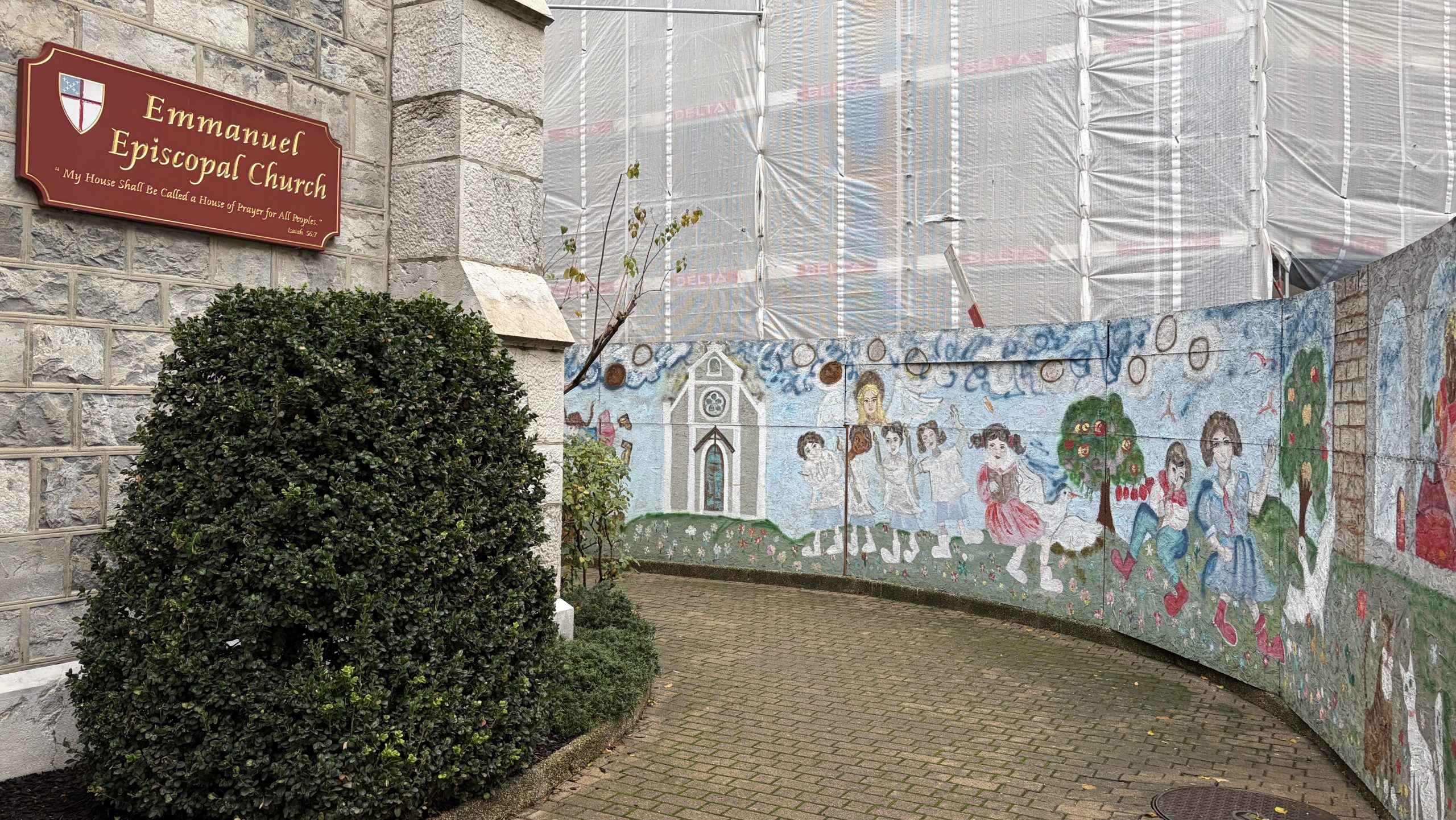
In its place stands a plywood wall that has been decorated on our side by Sunday school children with the help of Ukrainian refugees who are part of Emmanuel’s Refugee Welcome Center. Their mural depicts the church and children, along with birds and animals, fruit trees, flowers, and the Alps.
The bank has promised that when the construction project is finished, they will put the garden back “exactly the way it was.” But what if we could put it back better?
We will have a blank slate, a plot of bare dirt. We have an opportunity to create a little urban habitat for pollinators and birds, and maybe even small amphibians. We could teach our Sunday school students about finding and nurturing nature, even in the big city. And for the grownups, we could grow fresh herbs, flowers and maybe even a few vegetables for the soup kitchen and for our own Breaking Bread meals.
I have taken on the task of selling this project to the congregation. The most common reaction I get is that an environmental garden is a nice idea, but . . . What goes unspoken is that people want a pretty garden with flowers and shrubs, the way it used to be. An environmental garden will look like a bunch of weeds, the thinking goes.
But flowers are essential to an environmental garden. The more, the better, with something in bloom throughout the season. Flowers attract and nourish pollinators, which in turn help many fruit trees produce their fruit. And a garden with flowers, seeds, insects, and fruit can attract birds as well. In short, an eco-garden can be pretty, and a pretty garden can be a real miniature ecosystem.
But there are many questions to answer before we can begin to plan a garden like this. With tall buildings all around, would there be enough sunlight to grow sun-loving flowers like lavender? Would fruit trees be inviting birds to their deaths in a canyon of tall buildings with large expanses of glass? Would pollinators even be able to find our flowers in the middle of the city? I think the answer to that question is yes, given how quickly bees found my newly planted lavender this spring on the fifth floor of a newly built cement box in the city. Would fallen fruit attract our fellow urban dwellers, rats? If my experience is any guide, birds are very good at removing all the fruit from the tree the day before I decide it is ripe. None falls to the ground. Especially cherries.
Our group of amateur garden enthusiasts will clearly need to get some expert advice before we commit to this project, or we might indeed end up with a garden that looks like a bunch of weeds. If there is someone in your congregation with expertise in ecological gardening who might be willing to advise us, please let us know.
What Might Someday Be Possible?
A major intersection in the center of Geneva has been torn up for almost as long as I have lived nearby, thanks to the construction of GeniLac, an ambitious system designed to provide heating and cooling to buildings across much of the city.
Water drawn from deep in Lac Léman stays at 7°C year-round. It will be circulated through underground pipes, providing cooling to buildings around the city. In winter, heat pumps can extract heat from that same cold water and use it to warm buildings.
Cold water for heating? How is that possible? The scientists tell us that water always contains hot molecules and cold molecules. They tend to leave it at that. I will never understand how these machines separate hot ones from cold ones. It doesn’t matter. It is enough to know that this enormous renewable source of heating and cooling, dramatically reducing our dependence on fossil fuels is a gift of God’s creation just when we needed it.
Is Emmanuel going to connect to this system? That’s where it gets complicated. Plans for expanding the network are progressing, but the construction schedule is measured in decades. And depending on the efficiency of our existing heating system, the church might need significant upgrades to make use of the new technology.
Emmanuel is a beautiful 19th-century church, inside and out. Former U.S. President Ulysses S. Grant laid the cornerstone in 1877. There is absolutely no appetite within the congregation for replacing our stained-glass windows with double glazing or covering the stained oak ceiling of the Grand Salle with insulation and plasterboard.
Sooo, the bottom line is: Someday Emmanuel may be eligible to connect to the aquathermal system if it reaches our neighborhood, if we can make whatever energy upgrades might be required, and if we can do so without compromising a historically notable building in a historically sensitive area. That’s a big stack of waffles.
Let’s put some syrup on those waffles:
Even if the utility company brings the network to our doorstep, Emmanuel would still be responsible for the necessary equipment and modifications inside the building, including our very own molecule selection machine (otherwise known as a heat pump.) The system would pay for itself many times over in the long term, more than offsetting the high initial cost. But long-term return doesn’t pay the bills.
So perhaps GeniLac is a possibility for another day. In the meantime, we can wash our coffee cups, save a few trees’ worth of paper, and turn a little patch of city dirt into a place where flowers bloom, bees forage, and children discover the wonders of God’s creation. Creation care doesn’t always require grand projects. Sometimes it begins with finding out what is possible and then doing it.