“One of the most important aspects of our program is fostering connections, to create a space where migrants and their families feel welcomed, valued, and supported,” said Ruth Frederico, employment and social integration specialist for Frontiers of Hope, a project in the Convocation Refugee Grant Program (CRGP).
The project is part of St. Paul’s parish of the Lusitanian Catholic Apostolic Evangelic Church in Lisbon and is one of two CRGP projects in Portugal. “For us, the process of accompaniment seeks not only to respond to immediate needs, but also to create opportunities for each person to develop skills, find work, and rebuild their life with greater stability and hope,” Frederico continued.
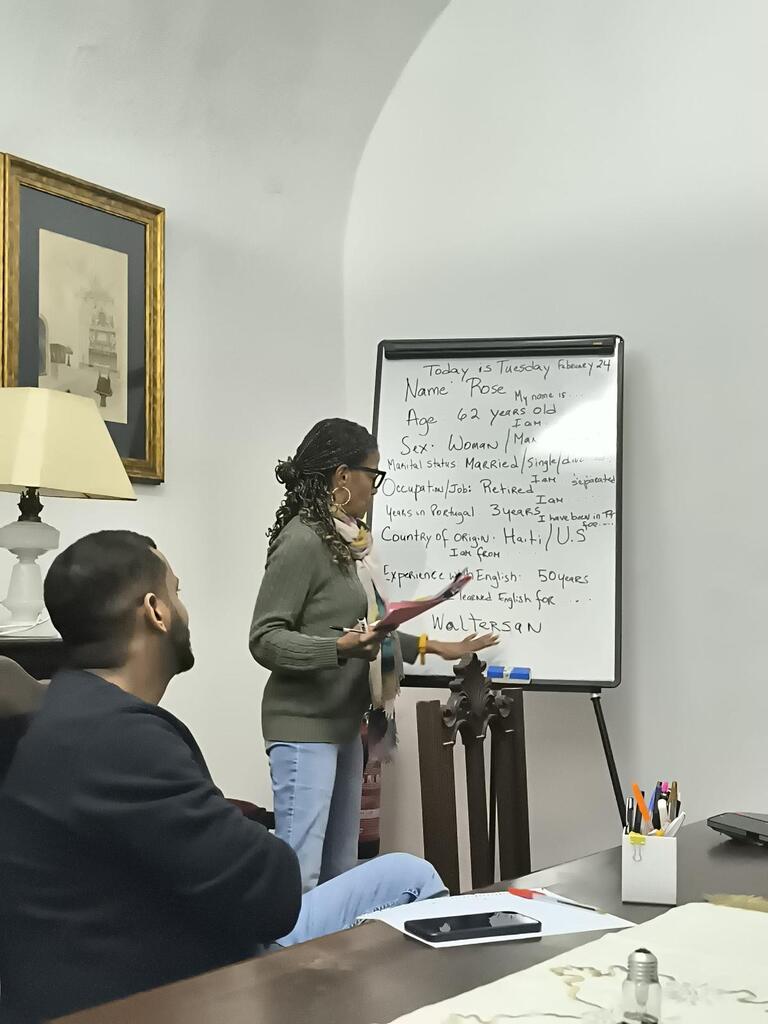
Providing English language classes is a core component of Frontiers of Hope. Many of the migrants who come to St. Paul’s are from Brazil or Angola and already speak Portuguese. “But they need English to have more options for work,” Frederico explained. Other refugees, often from Pakistan, need English rather than Portuguese for better job opportunities and pay. “The aim of the classes is not only to teach English but also to increase the confidence of the participants and facilitate communication in everyday life.”
The English classes are also a way for project volunteers to see what other help migrants might need to integrate into Portuguese society – short-term housing and rental assistance, someone to guide them through the immigration process, links to other social programs.
“One of the results of our workshops is that people help one another. We bring people together and, often, they resolve the problems between themselves,” Frederico observed. They also host lunches that bring people together, often sharing food from their home culture. “People are just happy to be together and to help one another. We are just a bridge.”
One of the project’s recent “success” stories is Christiano, a young Brazilian, who got a job as a hospital assistant as a result of the English classes. “This is so important because it demonstrates that monitoring, learning and encouragement can contribute to real changes in people’s lives,” Frederico observed. Another is a Pakistani boy who was afraid to speak English but needed it for his work in a restaurant. The classes enabled a better life by helping him break through his fear.
“One of my favorite stories is about Rose, our English teacher,” Frederico said with a smile. “She is from Haiti and lived in the United States for 40 years, but she doesn’t speak Portuguese. Now, by teaching the immigrants English, she’s also learning Portuguese.” The next phase of Frontiers of Hope is to continue English classes, reinforce existing workshops, and create new opportunities for training and professional integration and housing.